A sermon on Philippians 3:17-21 for the Twenty-Third Sunday after Trinity. Delivered by Pastor Caleb Strutz at Resurrection Lutheran Church in Winter Haven, Florida.
In the 2004 film The Terminal, Tom Hanks plays Viktor Navorski, who is trapped in an airport. Viktor was travelling to New York City from his home country of Krakozhia and during the flight a coup overthrows the government in his country. The US doesn’t recognize this new government so his passport is declared invalid; he is unable to either enter the United States or return to Krakozhia. He’s stuck in the airport. Now, there’s an easy way out. If he claims asylum, that he is afraid to return to Krakozhia, he can enter the United States. But he refuses to do so. Krakozhia is his home! How can he be afraid to go there? Viktor Navorski values his citizenship and recognizes how important it is for him and his identity, he’s not willing to let go of it so easily.
In our Epistle this morning, Paul tells us that “our citizenship is in heaven.” For the Philippians, this language carried a lot of meaning, and it has some very important implications for us. We are heavenly citizens, stranded for a time on this earth. Although we are surrounded and influenced by our enemies, God gives us his encouragement during this time of exile.
I. The Colony of Philippi
Citizenship probably isn’t something that you have to think about that often. The occasional political discussion is kinda abstract and doesn’t really affect you. Your citizenship probably doesn’t have a huge impact on your day-to-day life. But the situation was very different for the recipients of this letter, the Philippians. Paul is writing this letter from imprisonment in Rome to the Christians in Philippi, a city in Greece, which is 700-1200 miles away, depending on the route you take. And Philippi was a very special city.
In 42 BC, Anthony and Octavius, the heirs of Julius Caesar, defeated Cassius and Brutus, Caesar’s assassins, at the Second Battle of Philippi. Octavian returned to Rome and later became Caesar Augustus, whom we know from Luke 2.
After the Battle of Philippi, many victorious veterans settled there and Philippi became a Roman colony. And this is huge. For example, Judea was a Roman province. They had a governor appointed by the emperor, no legal rights besides that of paying taxes, and faced brutal oppression.
But Philippi was a Roman colony. This is Roman soil that just happens to be in Greece. The colonists had Roman citizenship and all of its legal rights and privileges, they elected their own senators, they were free from taxation. But this outpost of the Empire had to be willing to fight to protect the Empire, if needed.
Now, of the five people we know in connection to the church in Philippi, four have Greek names and only one has a Latin name, so it seems like most of the Philippian Christians weren’t Roman citizens. But they still knew what that meant.
In the Roman mind, there are two kinds of people: Romans and barbarians. The Romans were proud of their citizenship. They saw themselves higher than those around them and they acted differently. There are things that the barbarians might do, but a Roman would never stoop to that level. Although the city of Philippi was a Roman colony, it was surrounded by “barbarians,” by Greeks, and they lived in the city, too, and mingled with them. But you could tell who was a Roman just by looking at them. You could tell who was a Roman by how they held themselves, they had a distinct aura. You could distinguish a Roman by their attitude and their conduct.
II. The Colony of the Church
So Paul is telling these people, who probably aren’t Roman citizens, that they are citizens of heaven. Think of how much that would have meant to them and everything that goes into that. Our home is far away, somewhere we’ve never been, but that is where our citizenship and our loyalties lie. Christians, as citizens of heaven, are different from the world. We are going to behave and hold ourselves in a very different way, we’re not going to stoop to the level of this world. And we’re going to fight to defend this heavenly city.
And just as the city of Philippi was surrounded by barbarians, so the church on this earth is surrounded by enemies. When you look at our world and society, it doesn’t take you very long to tell just how corrupted and fallen and sinful it is. We see enemies on every side, we’re witnessing and experiencing the decline of Christianity firsthand. It’s demoralizing. But Paul draws our attention to a different enemy, a more dangerous enemy, the one inside the gates.
He warns against those who are “enemies of the cross of Christ.” Now these aren’t just the enemies of Christ, the blatant unbelievers, these are “enemies of the cross,” people who claim to be Christian, but reject that that means suffering and sacrifice in this life. He describes them, their “end is destruction,” they are destined for eternal death, their “god is their belly,” they serve the desires of their flesh, and their “glory is in their shame,” they boast of the sin which defiles them. They “set their mind on earthly things,” not spiritual things, not heavenly things.
This is strong condemnation. Think about how many claim to be Christian but reject everything that means. From the progressive pastor who preaches social justice from the pulpit instead of Christ to the “religious right” that isn’t even religious anymore, people of all stripes are desperate to hold onto the title or name of Christian, even if they reject everything it stands for, even though they are only focused on earthly things.
And when we look at ourselves, we see how we have been influenced and corrupted by all of our enemies. We are constantly bombarded by voices that are not the voice of our Shepherd, but would lead us away from him. We value and prioritize comfort and convenience and would rather avoid the cross.
We’re tired, isolated on this outpost of the empire, overwhelmed by opposition from without and within, vulnerable to the attacks of the enemy, homesick for a heavenly city that we’ve never even seen.
III. Encouragement for Heavenly Citizens
“For our citizenship is in heaven, from which we also eagerly wait for the Savior, the Lord Jesus Christ.” Though we see our enemies on every hill surrounding us, although the odds seem insurmountable, although it seems that we are fighting a losing battle, we watch the horizon. We wait to see the banner of the Lamb who had been slain, we wait to hear the trumpet call of our God, we wait for our Lord to return with legions of angels to break the siege and rescue His people. Then we, the citizens of heaven, who have held this post in the church militant against impossible odds, will be brought to a land which we have never seen but which is our home.
We are not prepared to enter there as we are. Our bodies are stained with sin, sick with the disease of death, weakened by the effects of living in this barbarbous land. So He “will transform our lowly body that it may be conformed to His glorious body.” By His death, Jesus has defeated death, and by His resurrection He has obtained the power “by which He is able even to subdue all things to Himself.” Although we must endure the attacks of our enemies in this world, Christ has conquered our greatest enemies. He took the corruption of our sin upon Himself, He suffered the death which was waiting for us, He crushed the head of the serpent which would devour us. He rose to new life, perfecting our fallen flesh, paving the way for us as the firstfruits from the dead. Christ has defeated our enemies for us and we long for the day when we will experience these things in full, when we will be rescued from the outposts of the empire, when we are recalled to our heavenly home.
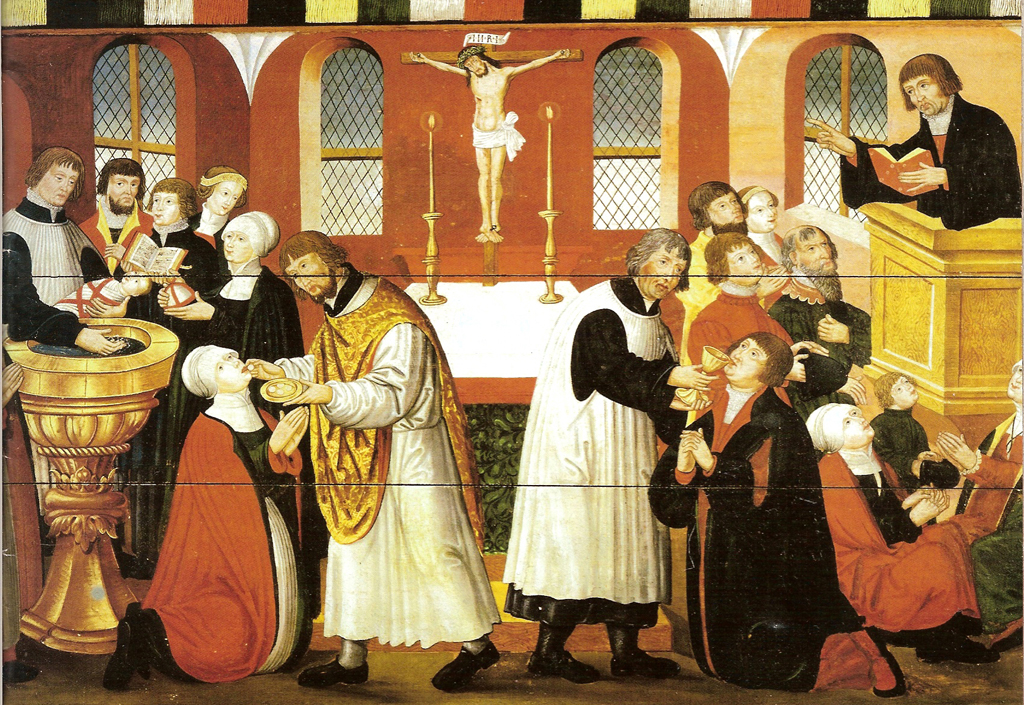
In the meantime, He offers us encouragement lest we grow discouraged or despair. We are citizens of heaven and He has given us a heavenly colony in the church. We are on holy ground, heavenly soil that just happens to be on earth. As we gather together around His Word and Sacrament, the lines between heaven and earth begin the blur. We enter the presence of God. This is the closest you can get to heaven.
Christ sends us the message of His Word, ensuring us that communication with our homeland is open, we are not as isolated as it might seem. He assures us that our sins are forgiven, that we are children of God, that our inheritance is waiting for our arrival. In His Supper, He dwells with us, physically, with His body and blood. There, we enter and enjoy his presence even more intimately. We receive a taste of heaven and the strength that we need to continue our fight on this earth.
He bids us, “Hold on a little longer. I am coming soon. Although the warfare is strong, I am victorious. Though all seems bleak, the field is mine. Hold on a little longer. I am coming soon.” Amen.