A sermon on Revelation 7:2-17 for All Saints’ Day. Delivered by Pastor Caleb Strutz at Resurrection Lutheran Church in Winter Haven, Florida.
A mixed metaphor is a figure of speech in which the images of two separate metaphors are inconsistently combined. Maybe you’ve heard someone say, “Well, that train has sailed.” Of course, this is combining two different metaphors (“the train has left the station” and “that ship has sailed”) but it doesn’t really make sense when they’re combined, trains don’t sail. Another one is, “It’s not rocket surgery.” Well, that isn’t a thing, but rocket science and brain surgery are two things generally considered to be extremely difficult. Some people use mixed metaphors intentionally for humorous effect, while others jumble them up accidentally.
As we remember the faithful departed this All Saints’ Day, we see them in the glories of heaven in our Epistle. There’s lots of rich imagery there for us to sit with and ponder and unpack. Some of those images seem contradictory, but this is not done unintentionally or for comedic effect, but to draw out the depth of the images involved. We see in the Lamb who shepherds and in robes washed with blood mixed metaphors of our salvation.
I. The Lamb who Shepherds
One of the main characters in the book of Revelation is the Lamb. He is really the focus of our text, surrounded by the 144,000 and the great multitude. We see the saints victorious and triumphant, whom we celebrate today, but we also see where their attention is drawn, where their focus is placed.
Jesus is the Lamb, as John the Baptist confessed, “Behold! The Lamb of God who takes away the sin of the world!” (Jn 1:29). Jesus is the sacrificial Lamb, whose blood atones for the world. That picture is pretty straightforward. But in our text, we read, “the Lamb who is in the midst of the throne will shepherd them.” Now that’s a mixed metaphor. Jesus is the Lamb and He’s our Good Shepherd, we’re familiar with both of those independently, but what on earth do those images have to do with each other? A lamb as a shepherd, isn’t that the blind leading the blind? Well, first, let’s explore how we see Jesus as the Good Shepherd in our text.
We see a lot of interplay between our text and the familiar language of Psalm 23. Again, very appropriate for All Saints’ Day, Psalm 23 is read at pretty much every funeral. As John looks into heaven, he sees the green pastures, the still waters, how God restores our souls. We see abundance, “my cup runneth over,” we see what it means to “dwell in the house of the LORD forever.” But, of course, this is only one side of the Good Shepherd coin. “Yea, though I walk through the valley of the shadow of death.” Here Revelation 7, we see that concept in the language of the “great tribulation,” that the Lamb is shepherding His people out of danger and into safety.
Now, some people get pretty out there when it comes to their interpretation of Revelation and the great tribulation. I don’t want to spend too much time on that. But it’s helpful to see what exactly this “great tribulation” is. As John looks at the believers in heaven, the elder tells him, “These are the ones who come out of the great tribulation.” I think that that language is significant. As believers enter heaven, being delivered from the great tribulation, they’re coming out, it’s an ongoing process, a trickle, not a one-and-done. While Jesus does tell us that things will get really bad right before the end (Mt 24), here the “great tribulation” seems to indicate the hardships the Church has to endure across the whole of time. And that’s how the word tribulation is used elsewhere in Revelation, to refer to the hardships experienced by John (1:9) and by the church in Smyrna (2:9-10), so this isn’t just a future thing, it’s a present, ongoing thing.
The point is, we see our Good Shepherd leading His people through tribulation, through trial and hardship and difficulty. Here’s where I think the main comfort of the Good Shepherd comes in. We might not be around for the end of the world, to see everything get as bad as it gets, but that doesn’t mean our lives are easy, that doesn’t mean that we don’t face our own tribulation. We might not see the moon turned to blood, but we do see wars and rumors of wars. We might not face martyrdom, but we do face ridicule for our faith and experience how the faith can divide and separate families. We all face our moments of walking through the valley of the shadow of death, as we face depression, despair, the death of a loved one, or even try to come to terms with our own death. There’s a lot that we need to be delivered from.
But as we face these things, we not only have the rod and staff of the Good Shepherd to comfort us, we know that the Lamb who was slain is our Shepherd. And that’s a mixed metaphor, but it’s one that brings deeper meaning.
I don’t want to get too lost in the weeds with what Lutherans think about the pope, but, despite all the things he got really wrong, the deceased Pope Francis did have a pretty good line about what it means for pastors to be shepherds. He encouraged his priests and bishops to be “shepherds with the smell of the sheep.” That they shouldn’t be hiding away in offices or holed up in bureaucracies, but with the people they serve and understand their needs and struggles. Our Good Shepherd, Jesus Christ, doesn’t just smell like the sheep. He’s not just rubbing shoulders with the flock. He is a sheep. He is the Lamb. Our Shepherd is one of us. The Lord is my Shepherd and my Shepherd is a human being just like me. That means that He not only knows and can empathize with your struggles, but more than that, that He can take your place.
The Lamb was slain because we deserve death, but He endured it for you. The Shepherd does not just lead us through tribulation, but as the Lamb He offered Himself as a sacrifice to face what was coming for His flock. He laid down His life for His sheep not only in their defence, but in their place. And He has taken up His life again to continue to shepherd His people (Jn 10:11-18). “The Lamb … will shepherd them” doesn’t make much sense, until you see that it is only as the sacrificial Lamb of God that Jesus delivers and rescues His people as their Good Shepherd. He has led the faithful departed out of the tribulations of this world and into the green pastures of heaven by His death and resurrection. And the Lamb will shepherd you throughout your life to join them in that heavenly flock.
II. Robes Washed in Blood
There’s one other mixed metaphor that I’d like to touch on in our text here because it’s so odd but it fits so nicely with the Lamb as the Shepherd. We talked about those “who come out of the great tribulation,” the believers who are being shepherded into heaven by the Lamb, but we’re also given this interesting image that they, who are dressed in white robes, have “washed their robes and made them white in the blood of the Lamb.”
Now blood is not a very good detergent. In fact, it leaves some of the worst and most difficult stains. I still have an undershirt with little specks of faded orange on it from a nosebleed I had years ago. If you wash something in blood, it’s not going to be white. But see what this tells us.
Isaiah says “all our righteousnesses are like filthy rags” (64:6). Standing on our own before God, we’re dressed rather shoddily. But we wash our robes in the blood of the Lamb. In the Old Testament, “according to the law almost all things are purified with blood” as we read in Hebrews (9:22), but we see its fulfillment as John writes, “and the blood of Jesus Christ His Son cleanses us from all sin” (1 Jn 1:7). The blood that was shed to rescue His flock covers His people. The blood of the Lamb not only washes away the dirt of our sin, it bleaches our garments, makes them white. Jesus takes away your sin and clothes you with His righteousness. We are covered by the merits of Jesus.
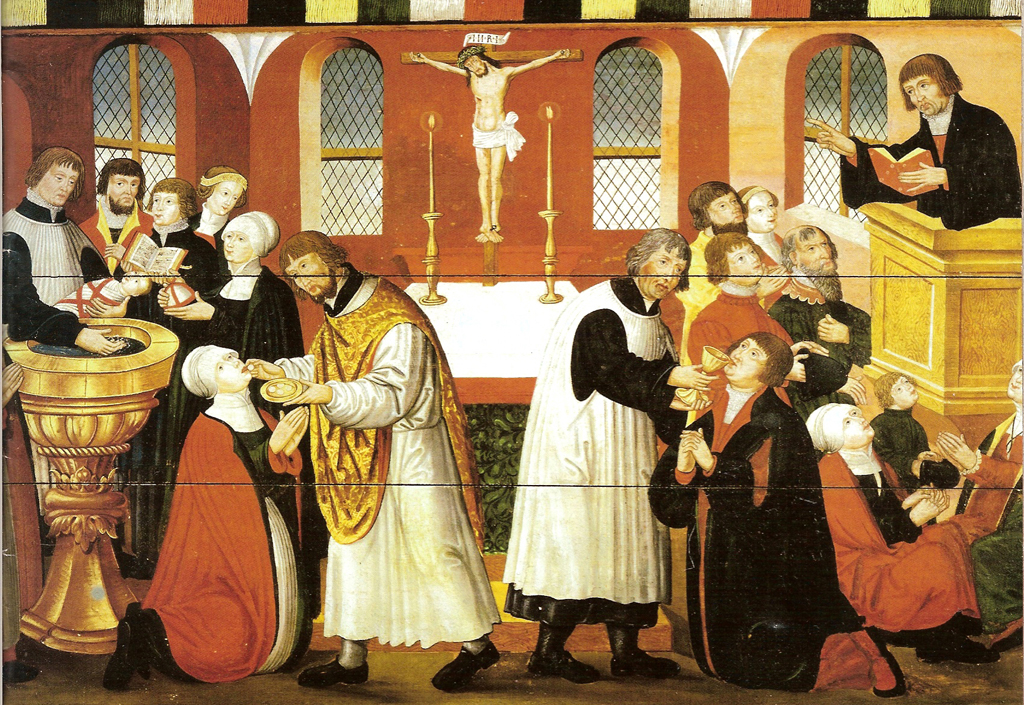
And that’s a bloodstain you’ll never get out. That’s a white that will never fade. No matter how dirty we get, we are washed and made white by the blood of the Lamb. That’s why pastors wear this robe, called an alb, from the Latin word for white, as a constant reminder for us and for you that we all are washed in the blood of the Lamb. Church is a small picture of heaven, where all the saints are clothed in white robes. That’s why babies, when they’re baptized, usually wear a white robe, a baptismal gown, as a picture of the forgiveness they receive in that Sacrament. We baptized Christians are all clothed in white, covered by Christ and His righteousness.
There’s a lot going on in our long text from Revelation, but now we can see how rich and layered this picture of Jesus as the Lamb is. Because the Lamb is the Shepherd. He was slain in the stead of His flock and by the shedding of His blood, He has rescued His people. He will lead us out of the tribulations of this life into the green pastures of the life to come, as He has for those who have gone before us. But now, as we walk through the valley of the shadow of death, as we hunger and thirst and grow weary, He comes to you with the white robe of your Baptism, the comforting voice of His Word, and the nourishing food of His Sacrament. Amen.